
Basketball Arcade Machine Buying Guide: 8 Features to Compare
This basketball arcade machine buying guide explains the main features buyers should compare before ordering commercial basketball games for an arcade, family entertainment center, shopping mall, indoor playground or leisure venue.
Basketball arcade machines offer a familiar and easy-to-understand playing experience. Customers throw basketballs toward the hoop within a limited time, while sensors record successful shots and the display shows the score. Different models may provide single-player, two-player or linked competitive gameplay.
However, cabinet dimensions, scoring systems, game modes, basketball return mechanisms, payment devices and construction quality can vary. A practical basketball arcade machine buying guide should therefore compare the complete operating configuration rather than choosing a machine only by cabinet appearance or purchase price.
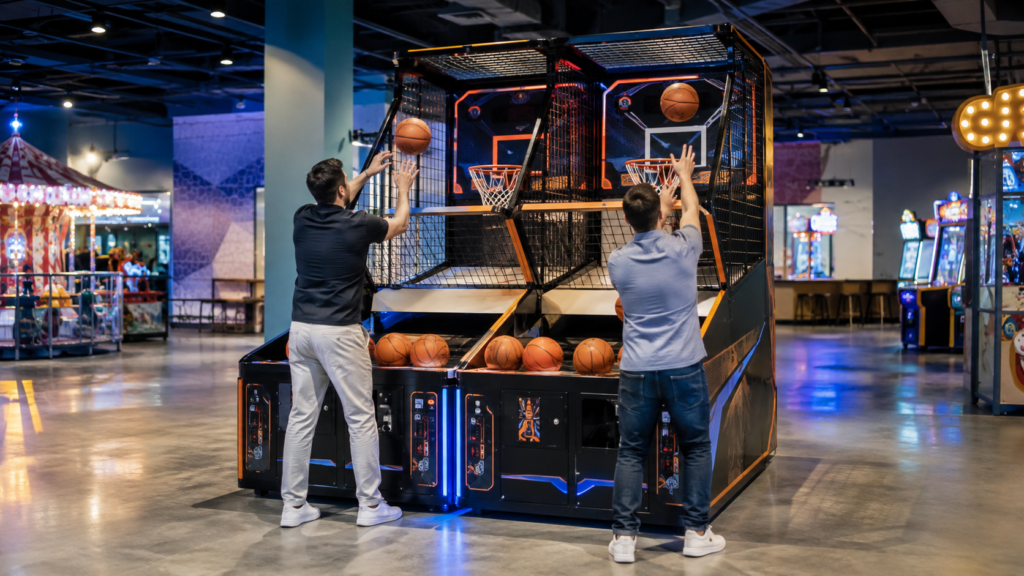
Basketball Arcade Machine Buying Guide: Define the Venue Requirements
Begin by identifying the intended location, available space and target customers.
A compact basketball game may suit a smaller arcade or indoor playground. A wider two-player machine can create a competitive experience for friends, families and groups, but it requires more installation space and may need a larger operating area in front of the cabinet.
Prepare the following information before requesting a quotation:
- Venue type and available floor area
- Target customer age range
- Required number of player positions
- Preferred coin, token or cashless payment method
- Destination country
- Local voltage, frequency and plug type
- Required language
- Preferred cabinet color or graphics
- Available entrance and elevator dimensions
- Estimated order quantity
If children are the main users, discuss the machine height, basketball size and throwing distance with the supplier. Equipment designed for adults may not provide a comfortable experience for younger players.
Tip 1: Choose Single-Player or Two-Player Gameplay
The first decision is whether to purchase a single-player or two-player basketball machine.
A single-player machine generally requires less floor space. It may be suitable for small game rooms, retail entertainment areas, restaurant waiting zones or venues that want to add a basketball game without occupying a large section of the floor.
A two-player machine allows customers to compete side by side. Competitive play can attract friends, couples and family members, especially when both sides operate at the same time and display individual scores.
Buyers should confirm whether a two-player cabinet is one complete machine or two independent units installed together. This distinction may affect packaging, transportation, electrical connections and maintenance.
Ask whether the units can operate separately if one player position requires service. Also confirm whether two or more machines can be linked and which additional cables, controllers or software settings are required.
Do not assume that cabinets with a similar appearance offer the same multiplayer functions. Request an operating video showing the exact configuration included in the quotation.
Tip 2: Check Dimensions, Hoop Height and Installation Space
Basketball arcade machines can be taller and deeper than many other amusement machines. Buyers must check both the operating dimensions and packed dimensions before ordering.
This basketball arcade machine buying guide recommends measuring the complete delivery route, including building entrances, corridors, elevators and venue doors. A machine may fit inside the planned operating area but still be difficult to move into the building.
Ask the supplier for:
- Machine width, depth and height
- Packed dimensions
- Net and gross weight
- Number of packages
- Required assembly space
- Recommended player area
- Service door clearance
- Ceiling clearance
- Basketball loading area
Confirm the hoop height and throwing distance. If the machine will mainly serve children, ask whether a lower or compact model is available. If adults and teenagers are the main customers, the playing dimensions should allow comfortable shooting without customers standing too close to the cabinet.
The machine should not block walkways, exits or nearby equipment. Leave sufficient space for players to collect basketballs, move their arms safely and wait for their turn.
Tip 3: Compare Scoring Sensors and Game Modes
Reliable scoring is essential because customers expect the displayed score to match the number of successful shots.
Most commercial basketball games use sensors around the hoop or ball passage area. The sensor position and software settings should reduce missed scores and unintended double counting.
This basketball arcade machine buying guide recommends requesting a continuous testing video. The video should show multiple successful and unsuccessful shots, the score display and the transition between game stages.
Ask the supplier about the available game modes. Depending on the selected model, settings may include:
- Standard timed play
- Progressive stages
- Increasing score requirements
- Single-player practice
- Two-player competition
- Adjustable game duration
- Bonus time
- High-score display
- Ticket or point output
Functions vary between models, so confirm which modes are standard and which require additional hardware or software.
Buyers should also ask how technicians test and replace the scoring sensor. A sensor located behind accessible panels may be easier to inspect than one that requires extensive cabinet disassembly.
Tip 4: Inspect the Basketball Return System
After every throw, the basketball should return smoothly to the player area. An unreliable return system can interrupt the game and require frequent staff assistance.
Check the shape, angle and material of the return ramp. Basketballs should roll toward the front without becoming trapped in cabinet corners or internal netting.
The number and size of basketballs should match the cabinet. Balls that are too large, too light or insufficiently inflated may not move correctly through the return system.
When following this basketball arcade machine buying guide, request a video showing a complete game with all supplied basketballs. Look for smooth ball movement during fast, repeated shooting.
Ask the supplier:
- How many basketballs are included?
- What basketball size is recommended?
- Can replacement balls be purchased locally?
- How are balls loaded into the machine?
- Can staff reach the return ramp easily?
- Which areas require routine cleaning?
- Can the ramp angle be adjusted?
- Is the ball release controlled mechanically or electronically?
If the machine uses a locking or release mechanism, confirm what happens after a power interruption and how staff can remove basketballs during maintenance.
Tip 5: Review Cabinet, Netting and Player Safety
The cabinet must remain stable during repeated commercial use.
Inspect the frame material, side panels, protective netting, backboard and front control area. Connections should be secure, and the assembled structure should not move excessively when customers play.
Side and top netting help keep basketballs inside the playing area. Confirm that the netting covers the necessary areas without blocking lights, sensors or service access.
The front control panel should have properly finished edges and protected buttons. The payment box and service doors should have suitable locks to prevent unauthorized access.
Ask for close-up photographs of:
- Cabinet frame connections
- Backboard and hoop
- Side and top netting
- Control buttons
- Coin or payment area
- Display screen
- Speaker openings
- Service doors
- Interior wiring
- Adjustable feet or wheels
If the machine needs to be fixed or stabilized after installation, request the manufacturer’s instructions. Operators should inspect bolts, frame connections, netting and the hoop regularly as part of routine maintenance.
The venue must also supervise equipment according to its local safety policies and customer age groups.
Tip 6: Confirm Payment, Ticket and Operating Settings
The payment system should match the venue’s existing operation.
Possible options may include coins, tokens, arcade cards or QR-based cashless payments. Availability depends on the machine configuration and the selected payment hardware.
This basketball arcade machine buying guide recommends providing technical information about any third-party card reader before production. Do not assume that every cashless system can connect directly to every machine.
Confirm whether staff can adjust:
- Price per game
- Number of credits per payment
- Game duration
- Stage requirements
- Score targets
- Sound volume
- Display settings
- Ticket or point output
- Free-play mode
- Difficulty settings
If the venue uses redemption tickets, ask which ticket dispenser is included and how the payout setting is controlled. Ticket and reward configurations should comply with local amusement regulations.
Request screenshots or an operating video of the settings menu. Staff should understand how to enter the management interface, change authorized settings and restore the machine after a temporary error.
Also ask whether the machine records play counts or other basic operating information. Confirm exactly which records are available rather than relying on a general claim about data management.
Tip 7: Check Electrical Requirements and Maintenance Access
Before ordering, confirm the destination voltage, frequency and plug type.
Voltage requirements vary between countries, and an incorrect configuration can cause installation delays or damage. Provide the complete destination information to the supplier instead of requesting only a general 110V or 220V version.
Ask for the rated power and recommended electrical connection. The venue should use a suitable outlet and arrange cables so that customers cannot trip over or pull them.
Maintenance access is also important. Technicians may need to inspect sensors, displays, lights, speakers, buttons, payment devices and internal wiring.
Prepare a routine maintenance checklist covering:
- Cleaning the display and backboard
- Checking the hoop and net
- Inspecting cabinet bolts
- Testing scoring accuracy
- Checking the basketball return ramp
- Inspecting payment devices
- Removing dust from ventilation areas
- Checking electrical connections
- Testing buttons and speakers
- Inspecting supplied basketballs
Ask which spare parts are most useful for the selected model. Small components such as buttons, sensors, switches and lights may be convenient to order with the original machine.
Operating manuals, wiring diagrams and troubleshooting videos can help local technicians communicate with the manufacturer after installation.
Tip 8: Confirm Customization, Packaging and Shipping
Customization allows the basketball machine to match a venue’s design and operating requirements.
Depending on the model, buyers may be able to discuss cabinet colors, exterior graphics, language, voltage, payment systems, game settings and lighting. Confirm the available options for the exact machine being purchased.
This basketball arcade machine buying guide recommends recording approved customization requirements in the quotation. Review drawings, cabinet colors and graphic designs before production begins.
Use only artwork, logos and characters owned or authorized by the buyer. A generic commercial design is safer when brand authorization is unavailable.
For international transportation, request:
- Final machine dimensions
- Packed dimensions
- Gross weight
- Number of packages
- Packing method
- Wooden-case details
- Assembly instructions
- Loading photographs
- Recommended spare parts
- Destination port information
Basketball machines may be partially disassembled to reduce shipping volume. Confirm which sections will be separated and whether installation videos are provided.
Before shipment, request a complete testing video showing the cabinet, scoring sensors, basketball return, screen, lighting, sound, payment system and multiplayer function.
Questions to Ask Before Ordering
Use this basketball arcade machine buying guide when comparing quotations from different suppliers.
Ask each supplier:
- Is the machine designed for one or two players?
- Can multiple machines be linked?
- What are the complete operating dimensions?
- What are the packed dimensions and gross weight?
- Which basketball size should be used?
- How many basketballs are included?
- Which scoring sensors are installed?
- Which game modes are available?
- Can game time and difficulty be adjusted?
- Which payment systems are supported?
- Can a card reader be installed?
- Is a ticket dispenser available?
- What voltage and plug will be supplied?
- Does the machine require assembly?
- Which spare parts are recommended?
- Are manuals and maintenance videos included?
- Can the supplier provide a testing video?
- What information is required to calculate shipping?
Compare the actual included configuration rather than selecting a supplier only by the lowest quoted price.
Plan the Basketball Machine’s Position
Basketball games require an appropriate location because players need room to stand, throw and wait.
They can be combined with commercial arcade machines such as racing simulators, shooting games, claw machines and redemption equipment. A balanced selection can provide different experiences for customers rather than repeating the same style of gameplay.
Place the basketball machine where it is visible but does not interfere with important walkways. Consider sound levels and avoid positioning the machine too close to quiet dining, cinema or retail areas.
Industry information from IAAPA can help operators learn more about amusement venue planning, equipment operation and visitor experience.
After installation, monitor scoring accuracy, basketball condition, customer flow and maintenance requirements. No amusement machine can guarantee revenue, so the purchasing decision should consider venue traffic, operating expenses and the complete equipment mix.
Choose Basketball Arcade Machines From LeChuang
LeChuang supplies commercial amusement equipment for arcades, family entertainment centers, shopping malls and indoor amusement venues.
Buyers can discuss basketball machine size, player capacity, cabinet design, payment method, ticket system, voltage, language, customization, spare parts and international packaging according to the selected model.
Product photographs, operating videos and configuration details can be provided for confirmation. Send LeChuang your venue type, destination country, available space, required quantity and preferred payment system to discuss suitable equipment.
Use this basketball arcade machine buying guide as a checklist before placing an order. Contact LeChuang to request available models, technical details, customization options and shipping information.